



It’s becoming increasingly difficult to find a modern office without a soundproof booth. They’ve become part of the furniture of contemporary working life, offering a convenient place to take a call, escape the surrounding noise or hold a private conversation.
But how do you know whether a booth will actually do what you need?
Start comparing manufacturers' claims and you’ll encounter decibels, acoustic classes, specialist linings and impressive wall specifications. They all sound reassuring. But what do they mean? How do you compare them? And what do they tell you about the experience of working inside a booth or the privacy of a conversation?
And, more to the point, what do you need to know about acoustics to buy a booth?
We’ve interviewed Troy Bouman, a PhD-qualified acoustics and noise engineering expert to give you the answers.
Troy has been quietly working away in the field of acoustics for two decades, most recently as a consultant helping organisations understand, measure, predict and solve complex sound and noise challenges. He knows how acoustic science links to the real business of making products that work.
But his role in this guide is to bring simplicity to the science. He gives an acoustician’s perspective to the questions that you need to answer, and to do it in a way that makes practical sense. You need a soundproof booth that will meet your everyday needs in your workplace, so let Troy explain what matters.
Over five concise chapters, the aim is to help you ask better questions, recognise useful evidence and judge performance against your own needs. Each chapter ends with something you can use when assessing a booth, rather than another technical term to remember. In summary, the five chapters will cover the following five things that Troy thought you ought to know before choosing a booth:
These five principles will help you look beyond manufacturers’ claims and choose a booth that does what you actually need it to.
Chapter 1
So You Want Soundproofing. But What Kind of Sound Do You Want to Proof Against?
Companies want people to be able to concentrate, make calls or hold private conversations. That’s why they buy soundproof booths. But before comparing products, there is a more useful question to ask: what sound problem do you actually want to solve?
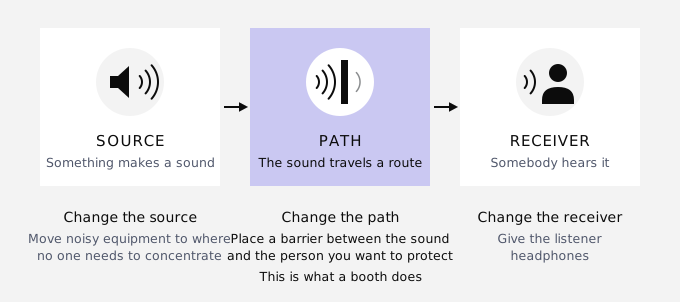
When acoustics experts like Troy consider a soundproofing exercise, they usually begin with a basic framework that makes this complicated subject a little easier to understand: source, path, receiver. Something makes a sound, that sound travels along a route, then somebody hears it. Understanding those three things gives an acoustician a starting point for deciding what needs to change.
Sometimes the simplest answer is to change the source. For example, you could simply move a noisy piece of equipment to a part of the building where no one needs to concentrate, and you remove the problem altogether. No need to buy anything.
Sometimes you can change the situation of the receiver, for example by giving them headphones. The main reason for buying a booth, however, is to change the path, placing a barrier between the sound and the person you want to protect.
Why Are Some Frequencies Harder to Block?
If you are looking to block sound, an important point to understand is that sound is not one uniform thing. Sounds arrive simultaneously in a range of frequencies. A low mechanical rumble and a higher-pitched voice can meet the same wall and experience very different reductions.
Acousticians explain this through wavelength. In the same way that waves in flowing water might bend around a rock, sound waves also bend around objects. These sound waves have physical lengths, and lower-frequency waves are longer. The low rumble of traffic can contain sound waves several metres long. The bright clink of a glass might have a wavelength of just a few centimetres. Both reach the same booth (and the same person within it), but they present very different acoustic challenges.
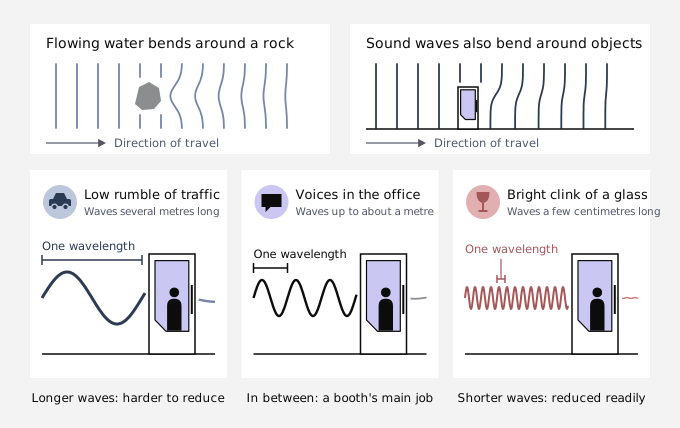
One familiar consequence is that low sounds with longer wavelengths are more difficult to reduce. Think of traffic outside a hotel: with the window closed, you may still hear a rumble. Open it and you suddenly hear a much broader range of sounds.
For a buyer, the useful lesson is that a booth’s performance changes across frequencies. A product that reduces ordinary office conversation effectively may leave more of a low mechanical hum audible, but that does not automatically mean it is badly designed. It may mean the sound you are asking it to tackle falls outside its intended brief.
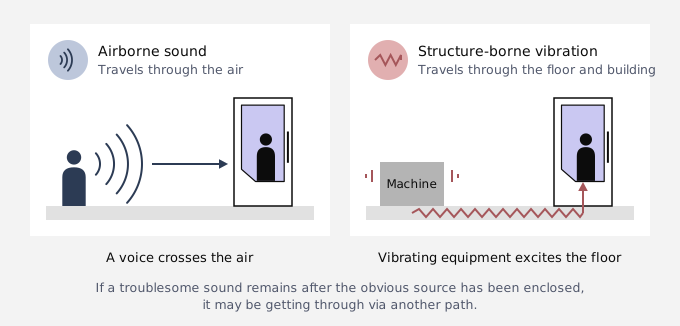
There is also a useful distinction to make between airborne noise and vibration travelling through a structure. A voice crosses the air; vibrating equipment can also ‘excite’ the floor or elements of the building construction. Describing everything as “noise” can conceal those different routes. If a troublesome sound remains after the obvious source has been enclosed, it may be getting through via another path.
This is why acousticians spend time establishing acoustic targets before considering materials. The starting point is the likely sound outside or inside the booth, followed by the conditions required where somebody will be listening.
How Much Soundproofing Do You Need?
The ultimate aim is perfect silence, right? Not usually. An acoustician would be more practical about it: decide which sounds need reducing, for whom and to what level.
Concentrating on a spreadsheet, recording a voiceover and discussing somebody’s salary are three different activities. They should not automatically be given the same acoustic brief simply because they happen in a booth. As Troy puts it:
Buyers should consider the consequences of failure: you’ve got to be a lot more careful in a top-secret military facility than you do in a community library.
Troy Bouman, PhDAcoustics and noise engineering expert
More demanding acoustic targets can mean a booth needs greater weight or more complex construction, both of which lead to higher cost. Those additions need to serve an identifiable purpose, or it is money wasted on over-specification.
For an office buyer, this need not become an engineering exercise. It means giving a supplier an honest picture of the surroundings, rather than expecting a standard product to solve an unspecified problem. The clearer the brief, the more meaningful the recommendation.
Chapter 2
Audibility v Intelligibility. Why Privacy Is Not the Same as Silence
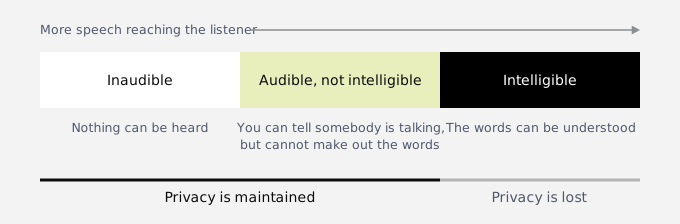
If you stand outside an occupied office booth, you can often tell somebody is talking, but you cannot make out the words. Some muffled sound has escaped but privacy has been maintained, and that was the goal.
For a private conversation, hearing a voice and understanding what it says are different outcomes. Acousticians like Troy see the distinction between audibility and intelligibility as one of the most useful ideas for anyone assessing what “soundproof” ought to mean.
Audibility concerns whether a sound can be heard. Intelligibility concerns how much of the speech can be understood. Reducing one does not give you a simple, universal answer about the other.
How Do Acousticians Measure Intelligibility?
The background sound where somebody is listening plays an important part. A voice that escapes into a busy office may be difficult to distinguish from everything around it. When the office empties, the same voice may become easier to follow even though the booth itself has not changed.
An acoustics expert therefore considers the speech reaching the listener relative to the background at that position. How loud somebody speaks matters too. A calm conversation and an animated call do not present identical challenges.
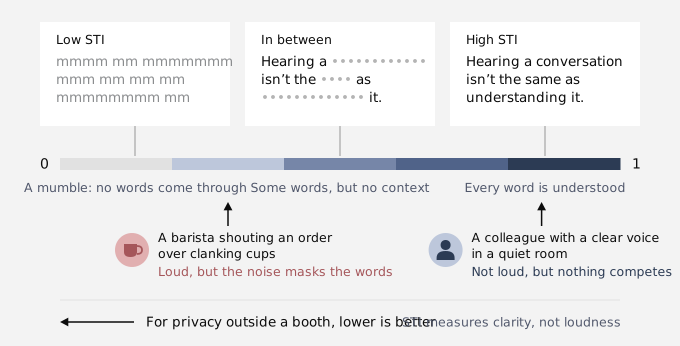
Troy refers to a measure called the Speech Transmission Index, or STI, to assess how intelligible speech is when it reaches a listener, taking account of factors including background noise and reverberation. Developed by Dutch researchers and now defined in an international standard, it uses a scale from zero to one, with higher scores indicating that speech is easier to understand. A colleague speaking with a clear voice in a quiet room will be a higher number: a barista shouting a coffee order over the clanking of cups in a coffee shop will be lower.
Why Does Background Noise Affect Privacy?
People also bring knowledge to what they hear. If that knowledge helps them to fill in the gaps, a lower STI number is required. Imagine a colleague already knows a conversation concerns salaries. A name and a number might reveal something meaningful, even if most of the sentence is lost. The listener’s knowledge can turn fragments into a message, whereas a stranger hearing those same fragments might learn very little.
Privacy therefore deserves assessment against plausible listeners and conversations, rather than a demonstration in which nobody knows what the speaker is discussing. That makes privacy a more demanding question than “Could you hear anything?” A demonstration should consider whether somebody can recover meaningful content, not simply notice a voice.
Does Soundproofing Work Both Ways?
Yes: acoustic scientists call it acoustic reciprocity. A soundproof booth will not only prevent conversations being heard outside, but also reduce incoming office noise for the person inside. As a general principle, and in typical office situations, a sound path works in both directions. But that does not make the two practical requirements identical. Quiet for concentration and privacy for a call involve different sources, listeners and expectations.
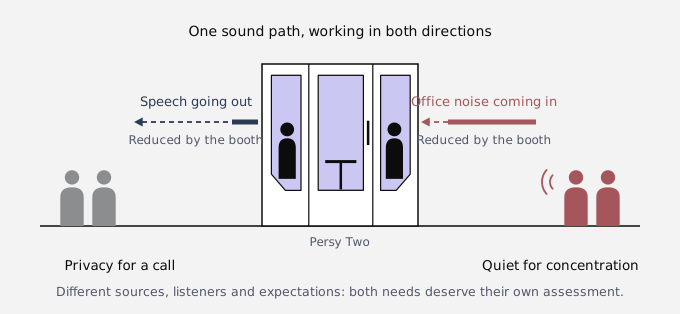
A booth can therefore be comfortable to work in without necessarily being suitable for every confidential conversation. Both needs deserve their own assessment.
Chapter 3
Finding the Weak Point: the Achilles Heel of Acoustics
If you build a house with thick concrete walls, you have an excellent barrier against sound from outside. But complement those walls with cheap, poorly sealed windows and you may as well have built your house from wood. The windows do not reduce the effectiveness of the concrete: they have simply introduced an easier route for sound. For Troy, this is one of the most fundamental parts of acoustics:
What happens in acoustics is that sound finds the easiest path. It’s an opportunist: if there’s a weakness, it will exploit it.
A booth specification may describe impressive wall panels, thick glass and carefully selected acoustic materials. Yet one of the most revealing things to inspect could be a small gap beside the door.
Acousticians know that sound can take several routes through an enclosure. The performance of one wall tells you about that wall. It does not establish the performance of the complete booth.
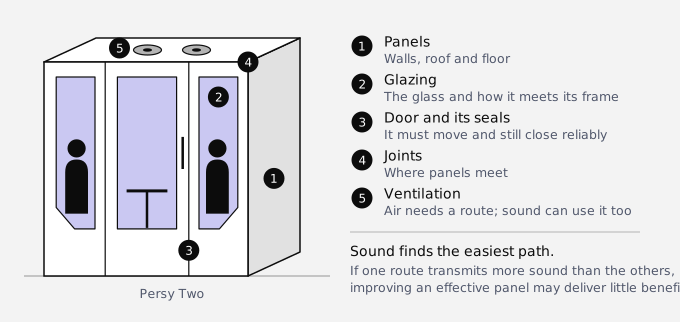
An office booth presents the same general challenge. Panels, glazing, doors, joints and ventilation all contribute. If one route transmits substantially more sound than the others, improving an already effective panel may deliver little benefit.
Why It’s Important to Consider the Whole Soundproofing System
Acousticians like to analyse the paths together. The design question is not just whether each material has good acoustic properties, but how much each route contributes to the sound that ultimately reaches the listener.
Doors deserve particular attention because they must move and still close reliably against their seals. A fixed panel can be joined permanently to its neighbours. A door must be opened, closed and used repeatedly without losing the contact its acoustic performance depends on.
Ventilation creates a further puzzle. People need air, so simply sealing every opening is not an option. But an easy route for airflow can also become an easy route for sound.
An acoustician would prefer a longer ventilation route with absorptive lining, giving sound repeated opportunities to interact with the material while air passes through the system. The absorption turns some acoustic energy into tiny amounts of heat. The challenge is to achieve useful attenuation alongside the required airflow.
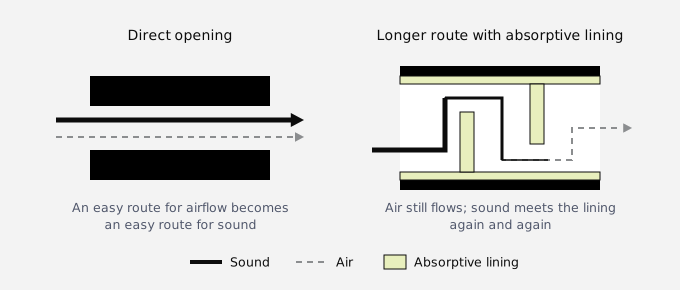
For buyers, the important distinction is between having a ventilation opening and having an acoustically considered ventilation system. Both may look unobtrusive from outside; their treatment of sound can be very different.
Persy Booths seeks to balance these routes against the performance target and cost. As Troy puts it:
You need something that is suited to the task. I guess sometimes you don’t need a Ferrari; you need a minivan.
The aim is to identify where additional material would improve the complete enclosure, rather than improving a specification in isolation, which would not deliver much additional value to the customer.
Windows deserve the same whole-construction thinking. Even well-performing glass must connect properly to its frame and adjacent panels. A buyer does not need to know the precise properties of every seal, but should recognise that the glazing specification and the quality of its installation answer different questions.
Nor should a ventilation solution be judged only on whether it suppresses escaping speech. The fan itself is another potential sound source. Ask to hear the booth with its normal ventilation operating: the equipment needed to make an enclosure comfortable should be included in your experience of it.
How Does Real-World Performance Compare to Theory?
Acoustics experts are always aware of the difference between computer drawings and manufactured products. In a model, two surfaces can meet perfectly. Real components in real life tend not to work so well. They have manufacturing tolerances for a start, and those small dimensional differences must be accommodated in the design and assembly. A carefully calculated enclosure can consequently underperform if the finished product leaves an unintended opening.
Also bear in mind that office requirements change and booths often have to be moved. If anything is going to put manufacturing quality to the test it will be the booth’s ability to withstand the move without opening up tiny cracks and fissures in the construction.
Chapter 4
Why a Booth Can Keep Sound Out and Still Sound Wrong Inside
When you enter a booth and close the door, the office noise falls away. Then you start speaking. Your voice may sound lively, even with a faint echo. If so, the acoustic solution is only doing half its job.
The problem is reverberation, and to understand why it happens, we need to make clear the distinction between blocking sound and absorbing sound.
What’s the Difference Between Blocking and Absorbing Sound?
When sound reaches a surface, three things can happen. Some sound passes through, some is reflected back, and some is absorbed by the material. Understanding the difference between these effects is fundamental to choosing a soundproof booth.
A substantial barrier, such as a concrete wall, can resist transmission while reflecting much of the energy back into the space. That reflected energy remains sound. The wall may keep it from the next room without removing it from this one.
A porous acoustic lining does something different. Air movement within its pores dissipates acoustic energy, converting some into tiny amounts of heat. That absorbed energy no longer exists as sound. The process has removed some sound by turning it into something else.
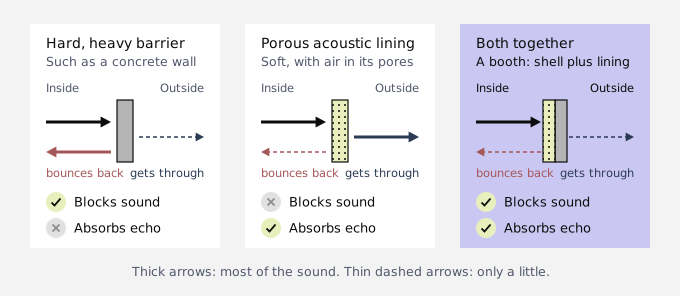
Both processes are important in the design of a soundproof booth, and different materials are used to perform each task. But an effective absorber need not provide much isolation on its own. Equally, a good sound-blocking wall need not absorb much at its surface. Mass helps explain barrier performance; the characteristics and thickness of porous treatment help explain absorption.
Mass really is the key for blocking sound. Product designers don’t like it, but the unfortunate reality is that if you want to block more sound, you need more mass.
But when you put the two together, the design becomes clearer. The shell limits what passes through. Internal treatment reduces reflections, helping control what the speaker and microphone experience inside.
Is There an Echo?
Those reflections also explain reverberation: sound persists after the source stops because energy continues travelling around the space. In a well-designed booth, soft lining materials prevent it from doing so.
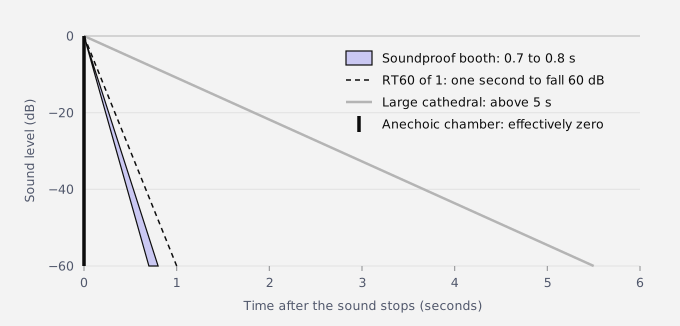
Acoustics people use a term called RT60, which means how long it takes for the sound level to fall by 60 decibels. Acousticians produce a test sound and measure its decay. If it takes one second, it’s an RT60 of 1.
To put that in perspective, a large cathedral might have an RT60 above five seconds, while at the other extreme an anechoic chamber has an RT60 of effectively zero. For comfort and practical purposes, a soundproof booth should have an RT60 of 0.7-0.8 seconds. A Bach organ concerto might sound amazing with a high RT60, but it’s not great for a business meeting. These are examples, not universal specifications: room size, purpose, frequency and occupancy affect the result.
From an acoustician’s point of view, understanding the combined effect of blocking and absorption is crucial because they both help meet the desired acoustic target. While the acoustic lining is there principally to absorb internal sound bouncing around, it nonetheless blocks some sound. That means less material is needed in the sound-blocking barrier. Which means you pay less for a booth that does the job you need.
Chapter 5
Making Sense of the Numbers
It’s all very well understanding the basics of acoustics. But if you’re buying a soundproof booth, you need to compare numbers. An acoustic rating gives a buyer something reassuringly simple to compare. One booth has a higher number than another. Surely the decision is obvious?
If you asked Troy, he would want to look at what sits behind the number. A rating is useful, but it compresses a more complicated result. And of course the important question is whether that result meets your requirement.
First: What Are Decibels?
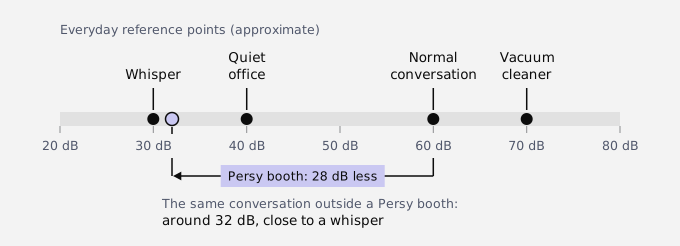
Decibels, or dB, describe sound levels and differences between them. As everyday reference points, a whisper might be around 30 dB, a quiet office around 40 dB, a normal conversation around 60 dB and a vacuum cleaner around 70 dB. These are approximate: distance and surroundings change what you hear.
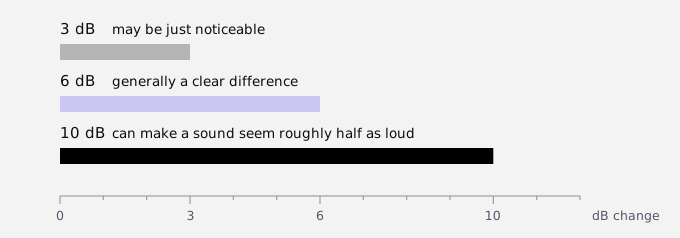
When comparing sound levels, acousticians like Troy use a few useful rules of thumb. A change of around 3 dB may be just noticeable, 6 dB generally represents a clear difference, and a reduction of 10 dB can make a sound seem roughly half as loud. These are approximations rather than guarantees: what people actually notice depends on the sound itself and the conditions in which they hear it. Troy explains that decibel measurements are often misunderstood:
One interesting thing about acoustics is that people worry about a 2 dB difference, even though they probably wouldn’t notice it if they heard it.
So a booth promising 25 dB reduction is describing a substantial difference, provided the figure comes from a relevant test. It does not mean “25 per cent quieter”. Nor does it tell you by itself whether somebody outside can understand the conversation within.
What About NRC, Rw and STC?
When you start researching which booth to buy, you may well hear these terms. They are useful, but they describe materials, not the overall sound reduction.
Rather misleadingly, NRC stands for “noise reduction coefficient”. However, it describes how good a material is at absorbing sound, not necessarily reducing the overall sound level. In chapter four, we looked at RT60: how long sound lingers in a space after somebody stops speaking. If you use materials with a higher NRC, you would expect a lower RT60. But it does not reliably describe the overall reduction in sound: a thick velvet curtain may absorb a lot of sound, helping to reduce reflections within a room, but you will still probably hear what they are talking about behind it.
Another way to describe how effectively a wall or other construction blocks sound is through its weighted sound reduction index (shortened to Rw). In North America, a similar measure called Sound Transmission Class (STC) is widely used. Both describe resistance to airborne sound, but they use different testing and calculation standards, so they are not directly comparable. And both are used to describe individual constructions rather than the performance of an entire office booth.
In short, NRC describes sound absorption, while Rw and STC describe sound insulation. All three are useful, but an ISO 23351-1 measurement of the complete booth is usually more relevant for booth buyers.
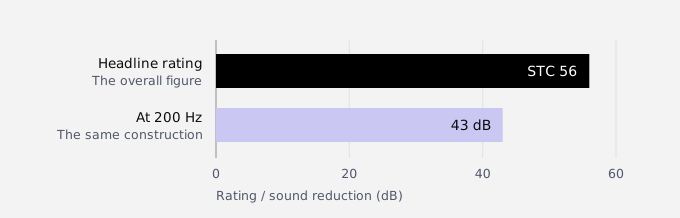
Bear in mind also that these ratings can hide important variations. Troy cites an example of a construction with an STC rating of 56, yet a sound reduction of only 43 dB at 200 Hz. That doesn’t mean the test failed, but rather illustrates how a strong overall rating can hide weaker performance at particular frequencies. If low-frequency noise is something you are concerned about, look at performance ratings in those frequency bands rather than just the headline figure.
Rating | What it measures | Why it matters |
|---|---|---|
NRC | How effectively a material absorbs sound | Helps assess effectiveness of acoustic treatment |
Rw | How effectively a construction resists airborne sound transmission (used in Europe) | Useful for comparing elements such as walls and panels |
STC | Similar purpose to Rw, using a different standard (used in US) | Useful for comparing elements such as walls and panels |
ISO 23351-1 | How much a complete enclosure reduces speech sound in a laboratory test | Most complete rating for comparing whole-booth speech reduction |
ISO 23351-1. The Ultimate Measurement?
ISO 23351-1 gives buyers a more convenient comparison by testing speech reduction from the complete booth. It is based on a laboratory method for comparing furniture ensembles and enclosures: it measures across frequency bands and combines the results into a single speech-level-reduction quantity. A useful single standard of acoustic performance, so you don’t have to judge its components separately.
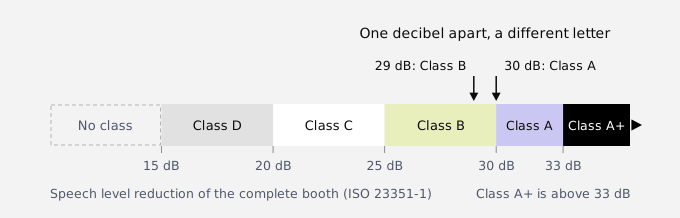
The standard gives us a speech reduction figure in dB, grouped into classes. Class A starts at 30 dB; Class B at 25 dB; Class C at 20 dB; and Class D at 15 dB. Class A+ is above 33 dB. Treat these as a useful guide to speech containment, rather than a promise of silence or confidentiality.
Bear in mind, however, that even laboratory testing is not immune to variation. Troy describes an exercise in which the same foam sample was sent to 20 different laboratories, with surprisingly different results. It’s a useful reminder that an impressive acoustic number is only as meaningful as the testing behind it.
Which ISO Class Do You Need?
A higher class generally means less speech escapes. That can matter in a quiet office, where even a faint voice is easier to hear, or where conversations are sensitive. In a busier office, background sound may mask the remaining speech, so a Class B booth may meet your needs. Ask the supplier to explain its recommendation for your setting.
Look at the measured number as well as the letter. A 29 dB booth is Class B and a 30 dB booth is Class A, but that one-decibel difference is unlikely to be noticeable in ordinary use. Troy is refreshingly pragmatic about the real value of such distinctions:
Sometimes we could easily do a little optimization to get a higher ISO rating, but we don’t because we know it doesn’t really help the customer.
Conversely, two Class A booths may achieve perceptibly different levels of reduction. The class makes comparison convenient; it does not tell the whole story.
But move that same booth into a very quiet library, and the conversation may become easier to hear. Place it in a much noisier environment, and the background sound may mask it more effectively. To put this in context, Troy gave the example of somebody speaking at around 65 dB inside a booth, while the surrounding office has a background sound level of approximately 40 dB. Therefore a reduction of 25 dB would bring the speech to around the same level as the background noise, making it harder for someone outside to distinguish the words.
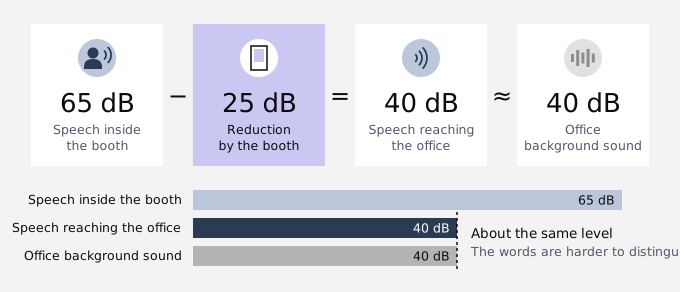
The lesson is that the amount of sound reduction you need depends partly on the sound levels outside the booth, not just the performance of the booth itself.
Around 25 dB is not always enough for privacy. In a quiet or typical office, a call can still be overheard several metres away.
Where the booth stands | 23–26 dBAround 25 dB | 28–30 dB | Over 30 dB |
|---|---|---|---|
Quiet officeLittle conversation, no music | More than 5 m | Within 3 m | 1–2 m |
Typical officeOccasional chatter, some music | Up to 3 m | 1–2 m | Under 1 m |
Loud areaConstant conversation | 1–2 m | Virtually inaudible | Inaudible |
Pay more for additional reduction when it brings a useful benefit. Balance it against price, space, ventilation, build quality and ease of moving the booth. For sensitive calls, test what a listener can understand outside: a class alone cannot guarantee privacy.
Take It With You
A Soundproof Booth Buyer’s Checklist
What acoustic problem am I solving: concentration, privacy or both?
How quiet or noisy is the surrounding workplace?
Has the complete booth been independently tested to ISO 23351-1?
Does the test cover the exact model and configuration I’m considering?
How effectively do the door, seals, glazing and ventilation prevent sound leakage?
Does speech sound natural and comfortable inside?
Can I test the booth with the ventilation going?
Am I paying for additional sound reduction that will make a meaningful difference?


John Bottom
Independent Journalist
John is an independent journalist who writes and reviews articles for Persy Booths. He interviewed Troy Bouman for this guide.
Troy Bouman, PhD
Independent Acoustics and Noise Engineering Consultant
Troy is a PhD-qualified acoustics and noise engineering expert. He has worked in the field of acoustics for two decades, most recently as a consultant helping organisations understand, measure, predict and solve complex sound and noise challenges.