They are trusted, valuable employees and colleagues - not chickens. So getting the right office space per employee is one of the most important facilities decisions any business will make. Too little space can lead to cramped desks and low morale, while too much can mean paying for square footage that sits empty. The goal is to strike the perfect balance – functional, comfortable, and cost-effective.
At Persy Booths, we work closely with companies planning new offices and redesigns. We see first-hand how careful space allocation affects productivity, wellbeing, and budget. Our role – supplying soundproof pods such as the Persy Work office pod that provide areas for focus and privacy – is only part of the formula, but the same rules apply. Spend wisely, and you get lasting value; overspend on the wrong things, and you risk waste.
Key takeaways from this article
- How to determine how much office space is needed per employee using proven benchmarks.
- How to divide that space between desks, common areas, and amenities.
- Simple formulas to calculate the office space you need – with real examples.
- Pros and cons of tight vs. generous office layouts.
- Why a thoughtful approach saves cost and improves satisfaction.
Determine How Much Office Space Is Needed Per Employee
Every company asks the same question when they move: how much office space do I need? The answer depends on your working style, the number of employees, and your balance between desk-based and collaborative work.
While national guidelines vary, the UK's Health and Safety Executive sets out legal space requirements that serve as a useful guide for the amount of office space required by companies around the world. Each worker should have at least 11 cubic metres of space – an area of roughly 4.6 m² (50 square feet per employee) assuming an average ceiling height of 2.4 m (or 7.8 ft). This is only a baseline; it doesn't account for furniture, walkways, or meeting rooms. Most offices need much more to be comfortable and compliant.
To judge the area needed for traditional offices, a good rule of thumb is 9–14 m² (97–151 sq ft) per employee, depending on role and layout. Open-plan environments often need less (around 9 m² / 97 sq ft per person), while private offices and client-facing roles typically need more – up to 18 m² / 194 sq ft per employee. Real estate experts AEW conducted research that showed that the per-employee amount of office space has decreased in recent years from 12 m² / 129 sq ft in 2000 to 9 m² / 97 sq ft in 2023, a 24% drop.
In hybrid work models, where employees spend part of the week remote, you can plan for fewer desks overall – but you'll still need ample shared areas for collaboration. The key is flexibility: fewer assigned desks, more communal areas, and well-equipped rooms for virtual meetings or focus work.
Determine How That Space is Divided
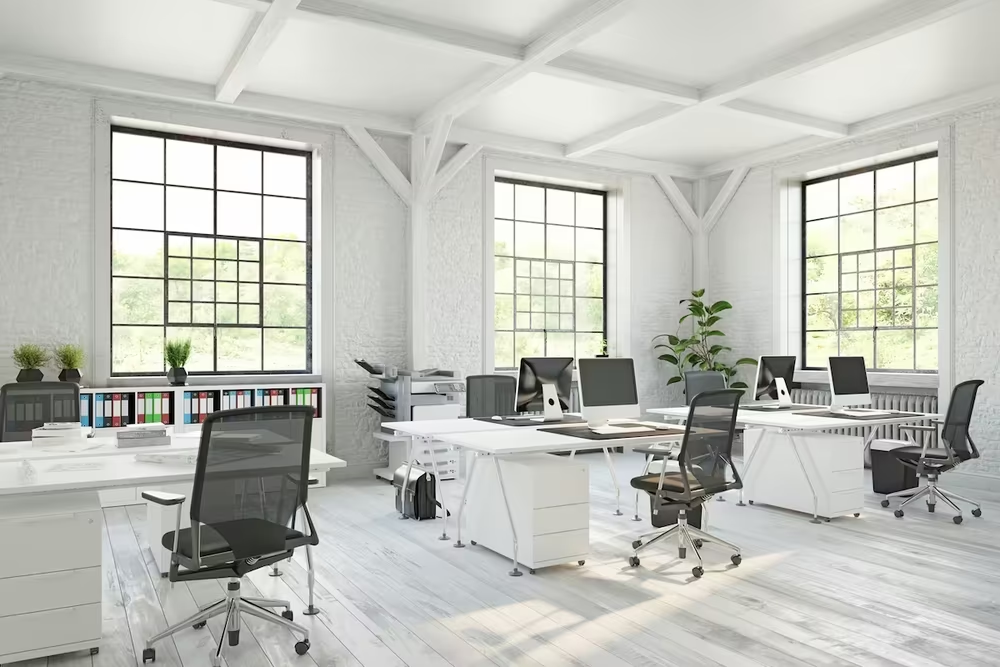
Once you know the total amount of office space per person, the next step is to divide it between workstations, common areas, and essential facilities. A good office design typically allocates around 60% to workstations and 40% to shared or support zones.
Below we look at how each category contributes to your overall space requirements.
Workstations and Dedicated Desks
The largest portion of space per employee is usually taken up by the workstation. A standard desk with chair, computer, and some movement allowance typically needs 4.6–6.5 m² (50–70 sq ft) per person.
In high-density or open plan environments, this may drop to 3.7–4.6 m² (40–50 sq ft), but comfort quickly diminishes if circulation or storage is ignored. For hybrid work, fewer dedicated desks mean you can reassign some of this footprint to breakout areas or meeting pods.
When calculating desk space, remember that every chair also needs access routes and clearance – especially important when planning accessibility in the workplace.
Common Areas and Meeting Rooms
Shared and communal spaces are crucial for collaboration and wellbeing, especially in collaborative workspaces. These include conference rooms, breakout zones, lounges, and even corridors. A typical guideline looks like this:
- Small meeting room (2–4 people): ~9.3 m² (100 sq ft)
- Medium meeting room (4–8 people): ~13.9 m² (150 sq ft)
- Large meeting room (15–20 people): ~18.6 m² (200 sq ft) or more
- Conference room or boardroom: 23–28 m² (250–300 sq ft) depending on seating style
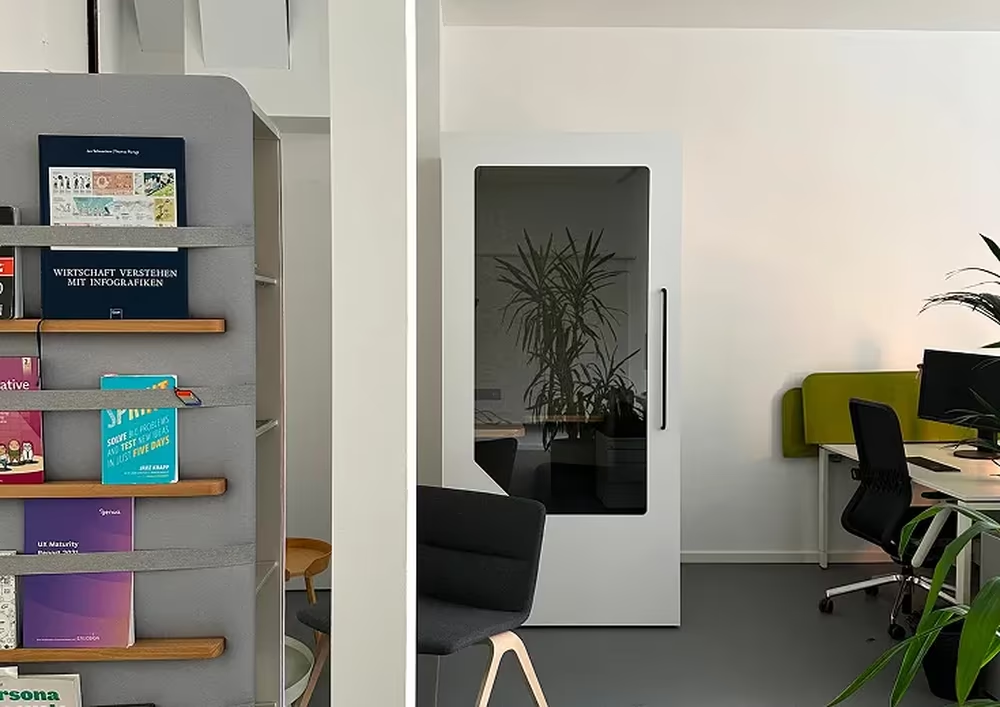
Including these rooms adds versatility and helps accommodate both full-time and part-time workers during overlap days. Adding office pods like the Persy One office booth is a space-efficient way to provide quiet zones without building extra walls.

Support Areas and Amenities
Supporting facilities – like kitchens, server rooms, storage, and restrooms – typically take up 10–20% of your total floor area. For example:
- Kitchen or breakout area: 9.3–13.9 m² (100–150 square feet) for small teams
- Storage or server room: 3.7–11.1 m² (40–120 square feet) depending on IT and filing needs
- Reception area: 7.4–13.9 m² (80–150 square feet) depending on visitor traffic
Even smaller offices benefit from some kind of informal social space – employees do not spend an entire day at their desks, and this should be taken into account in overall space planning.
How to Estimate Your Office Space Needs
Once you've defined your space allocation, you can calculate the office space you need using a few simple steps.
- Count your people – include full-time, part-time, and regular freelancers.
- Determine how much space per employee you want to allocate (e.g., 9 m² / 97 sq ft in open plan, 14 m² / 151 sq ft in private offices, 18.5 m² / 199 sq ft for senior roles).
- Multiply by the number of employees who will use the workspace on a typical day.
- Add 20–30% for common areas and circulation.
- Add 10–15% for future growth or reconfiguration.
For example: If you have 20 people, and your target is 14 m² / 151 sq ft per person, you'll need 280 m² / 3,014 sq ft for desks. Add 30% for shared areas (84 m² / 904 sq ft) and 10% for expansion (28 m² / 301 sq ft), and your total comes to about 392 m² / 4,219 sq ft.
If you want a quieter, higher-quality working environment, consider reallocating part of your amount of space for a privacy booth or two such as the Persy Four – compact, acoustically treated rooms ideal for calls and focus work.
To make this easier, most planners use a simple formula: Total space needed = (number of people × m² per employee) × 1.4 This accounts for desk space, common areas, and movement.
Pros and Cons of Different Space Allocations
Every office size and density comes with trade-offs. The goal is to find the right office for your people and budget. While it might seem self-evident, it is perhaps helpful at this stage to summarise the pros and cons.
Tight or High-Density Layouts
Advantages:
- Lower cost per square metre
- Efficient use of space
- Encourages interaction in open plan areas
Drawbacks:
- Can feel crowded
- Less privacy and concentration
- Limited space for future growth
Generous or Low-Density Layouts
Advantages:
- Improved comfort and focus
- More flexibility for office design changes
- Easier compliance with health and safety (e.g. 11 cubic metres per person)
Drawbacks:
- Higher rent and running costs
- Potential under-utilisation if many employees work remotely
So, how much office space per person is enough? For most businesses, a balanced space per employee approach – about 9–14 m² (97–151 sq ft) per person – delivers the best combination of efficiency and comfort. The picture is, however, more nuanced that that. Real estate experts CBRE note in their 2025 analysis that, while employee density has increased, office planners are taking more care in incorporating a variety of work environments and communal areas in order to reflect the increasingly varied office space requirements of employees. Hybrid work and flexible layouts may lower your total footprint, but the principle remains: allow room for focus, collaboration, and comfort.
At Persy Booths, we understand these challenges because we work with businesses every day that are planning smarter workplaces. If you plan carefully – accounting for desks, meeting rooms, communal spaces, and future growth – you'll end up with an office that's productive, adaptable, and welcoming.
Conclusion
Getting the right office space per employee is a careful balancing act between office costs, comfort, and long-term flexibility. By clearly understanding how much office space is needed, how that space is divided, and how meeting rooms, conference rooms, desk space, private offices, and shared areas are actually used, businesses can avoid paying for unused square footage through better workspace optimization. Decisions around office size, office layout, and square feet per person directly affect productivity, collaboration, and employee satisfaction.
A structured approach to office space planning and calculating office space helps organisations plan for future growth without overcommitting to a larger commercial space than necessary. Factoring in personal space, circulation routes, and the balance between shared spaces and quieter areas ensures employees are not forced to work in cramped conditions. Planning the average office space per person also makes it easier to compare options when securing new office space or renewing an existing lease.
Companies that regularly review their office space needed can adjust layouts as teams grow, reducing the risk of inefficient space utilization. Allowing for private meeting rooms and flexible desk arrangements helps accommodate different tasks without increasing overall office square footage. When businesses focus on creating the ideal office space and managing acceptable noise levels in the workplace, they are more likely to support wellbeing, collaboration, and sustainable business growth.
FAQs
.avif)
Passionate, progress-driven venture & business developer with startup and corporate experience. I speak business, while keeping customers in my heart.