




Decibels, NRC, STC and ISO classes can make choosing a soundproof booth feel like decoding a technical specification. Which numbers actually help you choose? Drawing on an interview with Troy Bouman, a PhD-qualified acoustics and noise engineering expert, we explain what common ratings measure – and what they cannot promise. This is an excerpt taken from the report An Acoustician’s Guide to Soundproof Booths.
Two booths sit side by side in a supplier showroom. One claims 29 dB speech reduction; the other claims 30 dB and carries a higher acoustic class. Is the more expensive one automatically the better purchase?
If you asked Troy Bouman, he would want to look at what sits behind the number. A rating is useful, but it compresses a more complicated result. And of course the important question is whether that result meets your requirement.
First – what does a decibel reduction actually tell you?
Decibels, or dB, describe sound levels and differences between them. As everyday reference points, a whisper might be around 30 dB, a quiet office around 40 dB, a normal conversation around 60 dB and a vacuum cleaner around 70 dB. These are approximate: distance and surroundings change what you hear.
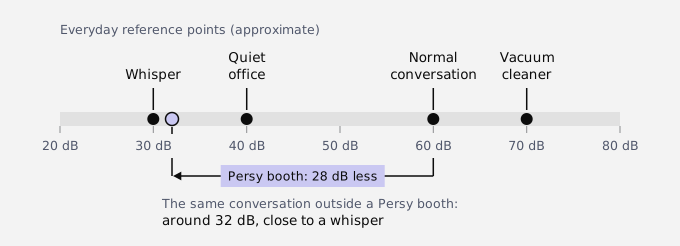
When comparing sound levels, acousticians like Troy use a few useful rules of thumb. A change of around 3 dB may be just noticeable, 6 dB generally represents a clear difference, and a reduction of 10 dB can make a sound seem roughly half as loud. These are approximations rather than guarantees: what people actually notice depends on the sound itself and the conditions in which they hear it. Troy explains that decibel measurements are often misunderstood: “One interesting thing about acoustics is that people worry about a 2 dB difference – even though they probably wouldn’t notice it if they heard it.”

So a booth promising 25 dB reduction is describing a substantial difference – provided the figure comes from a relevant test. It does not mean “25 per cent quieter”. Nor does it tell you by itself whether somebody outside can understand the conversation within.
What is the difference between NRC, STC and Rw?
When you start researching which booth to buy, you may well hear these terms. They are useful, but they describe materials – not the overall sound reduction.
Rather misleadingly, NRC stands for “noise reduction coefficient”. However, it describes how good a material is at absorbing sound – not necessarily reducing the overall sound level. If you use materials with a higher NRC, you would expect fewer echoes, less reverberation. But it does not reliably describe the overall reduction in sound: a thick velvet curtain may absorb a lot of sound, helping to reduce reflections within a room, but you will still probably hear what they are talking about behind it.
Another way to describe how effectively a wall or other construction blocks sound is through its weighted sound reduction index (shortened to Rw). In North America, a similar measure called Sound Transmission Class (STC) is widely used. Both describe resistance to airborne sound, but they use different testing and calculation standards, so they are not directly comparable. And both are used to describe individual constructions rather than the performance of an entire office booth.
In short, NRC describes sound absorption, while Rw and STC describe sound insulation. All three are useful, but an ISO 23351-1 measurement of the complete booth is usually more relevant for booth buyers.
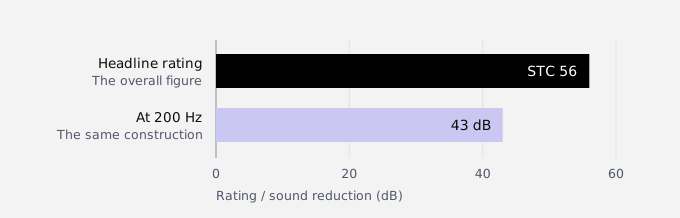
Bear in mind also that these ratings can hide important variations. Troy cites an example of a construction with an STC rating of 56, yet a sound reduction of only 43 dB at 200 Hz. That doesn’t mean the test failed, but rather illustrates how a strong overall rating can hide weaker performance at particular frequencies. If low-frequency noise is something you are concerned about, look at performance ratings in those frequency bands rather than just the headline figure.
What does ISO 23351-1 Class A mean?
ISO 23351-1 gives buyers a more convenient comparison by testing speech reduction from the complete booth. It is based on a laboratory method for comparing furniture ensembles and enclosures: it measures across frequency bands and combines the results into a single speech-level-reduction quantity. A useful single standard of acoustic performance, so you don’t have to judge its components separately.
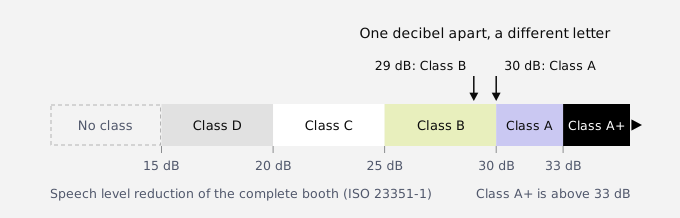
The standard gives us a speech reduction figure in dB, grouped into classes. Class A starts at 30 dB; Class B at 25 dB; Class C at 20 dB; and Class D at 15 dB. Class A+ is above 33 dB. Treat these as a useful guide to speech containment, rather than a promise of silence or confidentiality.
Bear in mind, however, that even laboratory testing is not immune to variation. Troy describes an exercise in which the same foam sample was sent to 20 different laboratories – and came back with surprisingly different results. It's a useful reminder that an impressive acoustic number is only as meaningful as the testing behind it.
Is it worth paying more for Class A?
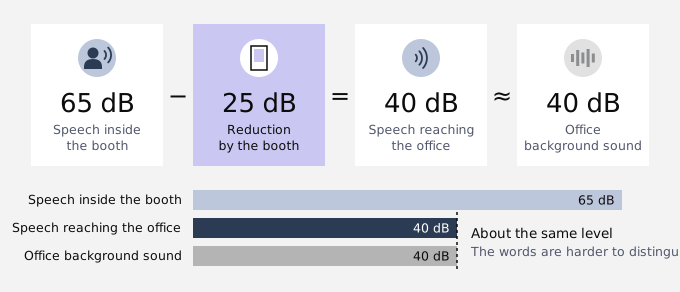
A higher class generally means less speech escapes. That can matter in a quiet office, where even a faint voice is easier to hear, or where conversations are sensitive. In a busier office, background sound may mask the remaining speech, so a Class B booth may meet your needs. To put this in context, Troy gave the example of somebody speaking at around 65 dB inside a booth, while the surrounding office has a background sound level of approximately 40 dB. Therefore a reduction of 25 dB would bring the speech to around the same level as the background noise, making it harder for someone outside to distinguish the words.
Look at the measured number as well as the class. A 29 dB booth is Class B and a 30 dB booth is Class A, but Troy is refreshingly pragmatic about the real value of such distinctions: “You can be at the high end of a Class B rating or you could be at the low end of Class A, and you won’t be able to tell the difference.” Conversely, two Class A booths may achieve perceptibly different levels of reduction. The class makes comparison convenient; it does not tell the whole story.
The lesson is that the amount of sound reduction you need depends partly on the sound levels outside the booth, not just the performance of the booth itself.
Pay more for additional reduction when it brings a useful benefit. Balance it against price, space, ventilation, build quality and ease of moving the booth. For sensitive calls, test what a listener can understand outside: a class alone cannot guarantee privacy.
Frequently Asked Questions
What does ISO 23351-1 Class A mean?
It indicates a high level of measured speech reduction for a complete enclosure under the relevant laboratory method. In the classification used in this guide, Class A begins at 30 dB. It is a useful comparison, but it does not by itself promise silence or confidential conversations in every office.
Is 30 dB soundproofing worth paying extra for?
Only if the additional reduction changes the outcome you need. A booth measured at 30 dB may cross a class threshold while a 29 dB booth sits just below it, despite a small practical difference. Compare the actual test values, your background noise and the cost of the upgrade.
What is the difference between NRC, STC and Rw?
NRC describes sound absorption by a material. STC and Rw describe airborne sound insulation of constructions, using different methods. None of these alone establishes the speech reduction of a finished office booth. For that comparison, ask for an appropriate complete-enclosure test, such as ISO 23351-1.