

We deliver across Europe. Standard products are delivered within 3 weeks.
Learn more
Menu
Get a Personalized Quote

Tell us what you're looking for and we'll create a quote tailored to your space, team and needs.

You'll receive:
  • A personalized recommendation
  • Clear pricing based on your request
  • A quick follow-up if we need more details
Persy One
For phone calls and video meetings.
€3999
(excl. shipping & VAT)
Persy Work
For deep-focus tasks and extended work sessions.
€4699
(excl. shipping & VAT)
Persy Two
For two-person meetings and video conferences.
€9499
(excl. shipping & VAT)
Persy Four
For small team catch-ups and discussions.
€11799
(excl. shipping & VAT)
You're All Set!
Thank you! Your request has been successfully submitted. We'll get back to you shortly with your personalized quote.
Close this window
Close this window
Oops! Something went wrong while submitting the form.
Download a Brochure
What you’ll find inside:
  • Product information
  • Product pricing
  • Technical information
Download a Brochure
You're All Set!
Thank you for your interest in Persy Booths! We've sent the brochure to the email address you provided. Please check your inbox for more information.
Oops! Something went wrong while submitting the form.

Optimized Airflow Design
‍
Each booth is engineered with strategically placed vents that maximize airflow efficiency, ensuring a comfortable environment for every user.

‍Consistent Temperature Management
‍
Our advanced ventilation system helps regulate temperature, ensuring a comfortable climate that keeps you cool and focused during long sessions.

‍Whisper-Quiet Operation
‍
Designed for a distraction-free experience, our ventilation system operates silently, allowing you to concentrate on your work without interruptions.

Soundproofed for confidentiality

Five Layers of Soundproofing Materials
‍
Designed to absorb and reflect a wide range of sound frequencies, these layers work together to enhance overall sound isolation.

‍Rubber-Magnetic Door Seal
‍
This seal ensures that even the smallest gaps are sealed tight, preventing sound leakage and enhancing privacy.

‍Double Acoustic-Grade Glass
‍
Our high-quality glass not only allows natural light to enter but also significantly reduces sound transmission, maintaining a peaceful atmosphere.

‍Recycled PET Felt
‍
This eco-friendly material absorbs sounds and echoes within the booth, ensuring a quiet environment for focused work and conversations.

Sound-treated ventilation channels
Every Persy Booth has sound traps in ventilation channels that absorb the sounds entering or escaping the booth through ventilation channels.

Acoustician Guide #4: Why a Booth Can Keep Sound Out and Still Sound Wrong Inside

— minute read3 figures

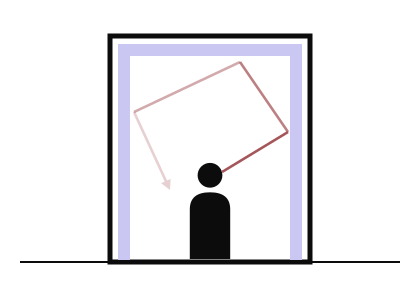
A voice reflecting off the walls inside a booth, fading as the lining absorbs it.
Expert contributorTroy Bouman, PhD, MSE, MBAAcoustics Specialist
“Understand the noise risk, evaluate practical options, and document the result clearly.”
Written byJohn BottomIndependent Journalist

A booth can keep office noise out and still be an unpleasant place to talk. Why? Because blocking sound and absorbing it are different jobs. Drawing on an interview with Troy Bouman, a PhD-qualified acoustics and noise engineering expert, we explore the importance of reflections, reverberation and internal acoustic comfort. This is an excerpt taken from the report An Acoustician’s Guide to Soundproof Booths.

Having a conference call with a large team of people is not easy at the best of times. Yet when those voices start to echo and reverberate around the room you’re listening in, it becomes harder still.

The problem is reverberation – and to understand why it happens, we need to make clear the distinction between blocking sound and absorbing sound.

What is the difference between soundproofing and sound absorption?

When sound reaches a surface, three things can happen. Some sound passes through, some is reflected back, and some is absorbed by the material. Understanding the difference between these effects is fundamental to choosing a soundproof booth.

A substantial barrier, such as a concrete wall, can resist transmission while reflecting much of the energy back into the space. That reflected energy remains sound. The wall may keep it from the next room without removing it from this one.

A porous acoustic lining does something different. Air movement within its pores dissipates acoustic energy, converting some into tiny amounts of heat. That absorbed energy no longer exists as sound. The process has removed some sound by turning it into something else.
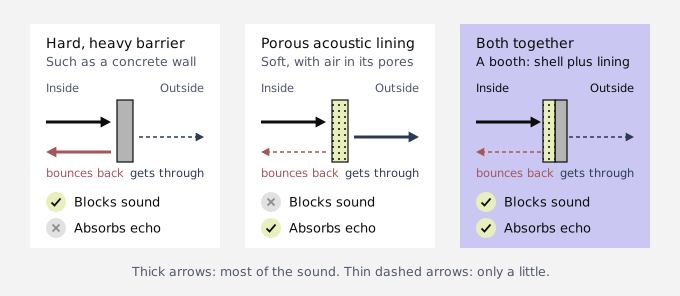
A hard, heavy barrier blocks sound but bounces it back as echo. A porous acoustic lining absorbs echo but lets sound through. A booth uses both: the shell blocks sound and the lining absorbs it.
Figure 1 Blocking and absorbing are different jobs, done by different materials. A booth needs both: the shell limits what passes through, the lining reduces reflections. Illustrative.

Both processes are important in the design of a soundproof booth, and different materials are used to perform each task. But an effective absorber need not provide much isolation on its own. Equally, a good sound-blocking wall need not absorb much at its surface. Mass helps explain barrier performance; the characteristics and thickness of porous treatment help explain absorption. As Troy explains. “If we’re thinking about blocking sound, it’s mass that matters. If we’re thinking about absorbing sound, it’s more about the thickness of the material.”

But when you put the two together, the design becomes clearer. The shell limits what passes through. Internal treatment reduces reflections, helping control what the speaker and microphone experience inside.

Why does a room sometimes sound echoey?

Those reflections also explain reverberation: sound persists after the source stops because energy continues travelling around the space. In a well-designed booth, soft lining materials prevent it from doing so.

Acoustics people use a term called RT60 – which means how long it takes for the sound level to fall by 60 decibels. Acousticians produce a test sound and measure its decay. If it takes one second, it’s an RT60 of 1\.

To put that in perspective, a large cathedral might have an RT60 above five seconds, while at the other extreme an anechoic chamber has an RT60 of effectively zero. For comfort and practical purposes, a soundproof booth should have an RT60 of 0.7-0.8 seconds. A Bach organ concerto might sound amazing with a high RT60, but it’s not great for a business meeting. These are examples, not universal specifications: room size, purpose, frequency and occupancy affect the result.
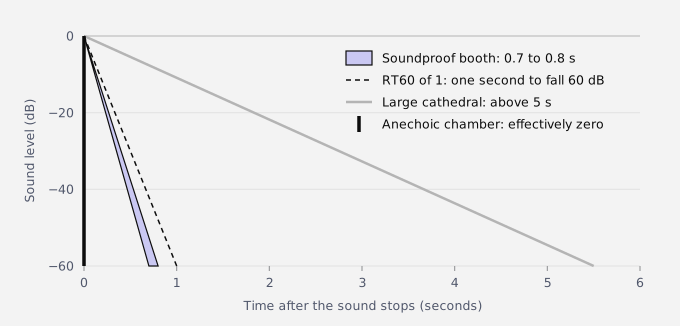
RT60 is the time a sound takes to fall by 60 decibels: effectively zero in an anechoic chamber, 0.7 to 0.8 seconds for a soundproof booth, and above five seconds in a large cathedral.
Figure 2 RT60 is how long it takes for the sound level to fall by 60 decibels. Examples, not universal specifications.

From an acoustician’s point of view, understanding the combined effect of blocking and absorption is crucial because they both help meet the desired acoustic target. While the acoustic lining is there principally to absorb internal sound bouncing around, it nonetheless blocks some sound. That means less material is needed in the sound-blocking barrier. Which means you pay less for a booth that does the job you need.

Frequently Asked Questions

What is the difference between soundproofing and sound absorption?

Soundproofing usually refers to limiting sound transmission between spaces. Sound absorption reduces reflections within a space, making speech less reverberant. A soft acoustic lining may improve comfort without providing a strong barrier to sound outside. A good office booth needs both functions considered together.

Why does a booth sound echoey?

Hard, reflective internal surfaces can cause sound to bounce around after someone speaks, producing reverberation or flutter. A booth may therefore isolate office noise well but still sound unpleasant on calls. Try speaking and recording inside, and ask how the manufacturer assessed internal acoustic treatment.

Will adding foam make my booth more soundproof?

Foam or other porous lining can help absorb internal reflections, but it is not a substitute for a well-sealed, appropriately constructed enclosure. If colleagues can understand speech outside, inspect doors, joints and the whole-booth test result rather than assuming more internal foam will fix the leakage.

Want to Learn More From Troy?

Troy’s interview was used as a base for a series of blogs, covering a number of topics that help booth buyers understand the science behind soundproofing. Explore by clicking the links below:

Read the Full Guide

An Acoustician’s Guide to Soundproof Booths

A complete five-part explanation of the science and practical buying decisions.

Read the Full Guide
John Bottom

John Bottom

Independent Journalist

John is an independent journalist who writes and reviews articles for Persy Booths. He interviewed Troy Bouman for this guide.

Troy Bouman, PhD

Troy Bouman, PhD

Independent Acoustics and Noise Engineering Consultant

Troy is a PhD-qualified acoustics and noise engineering expert. He has worked in the field of acoustics for two decades, most recently as a consultant helping organisations understand, measure, predict and solve complex sound and noise challenges.

Let’s Find a Booth That Fits Your Needs

Get a Quote

Tell us what you need, and we’ll send you a tailored quote. Fast, transparent, and commitment-free.

Get a Quote
Get a Quote
Download Brochure

Want to explore more first? Download our brochure for a detailed overview of our products.

Download Brochure
Download Brochure
Find a Showroom

Want to experience Persy Booths in person? Find a showroom across Europe and choose with confidence.

Find a Showroom
Find a Showroom