


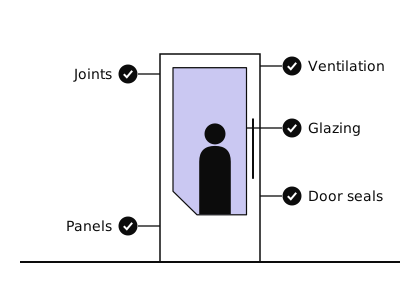


A booth might have impressive walls and high-performance acoustic materials. But what happens if there’s a tiny gap around the door? Drawing on an interview with Troy Bouman, a PhD-qualified acoustics and noise engineering expert, we explain why good soundproofing depends on the complete enclosure, not just its strongest components. This is an excerpt taken from the report An Acoustician’s Guide to Soundproof Booths.
If a castle has thick stone walls, yet leaves the gate open and the drawbridge down, it is defenceless. This is a metaphor worth remembering if you are buying a soundproof booth. A booth specification may describe impressive wall panels, thick glass and carefully selected acoustic materials. Yet one of the most revealing things to inspect could be that small gap beside the door.
Acousticians know that sound can take several routes through an enclosure. The performance of one wall tells you about that wall. It does not establish the performance of the complete booth. So the small gap by the door does not reduce the effectiveness of the wall panels – it simply introduces an easier route for sound.
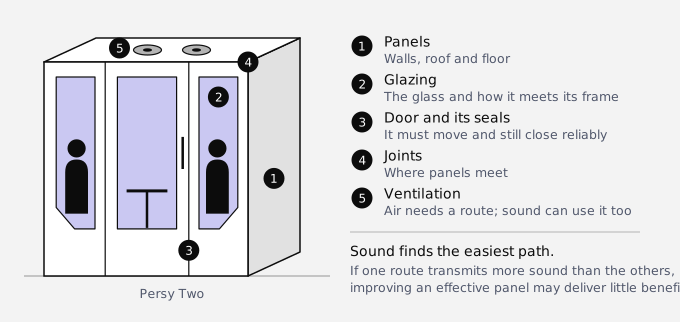
An office booth presents the same general challenge. Panels, glazing, doors, joints and ventilation all contribute. If one route transmits substantially more sound than the others, improving an already effective panel may deliver little benefit.
Why do booth doors and ventilation matter so much?
Acousticians like to analyse the paths together. The design question is not just whether each material has good acoustic properties, but how much each route contributes to the sound that ultimately reaches the listener.
Doors deserve particular attention because they must move and still close reliably against their seals. A fixed panel can be joined permanently to its neighbours. A door must be opened, closed and used repeatedly without losing the contact its acoustic performance depends on.
Ventilation creates a further puzzle. People need air, so simply sealing every opening is not an option. But an easy route for airflow can also become an easy route for sound.
An acoustician would prefer a longer ventilation route with absorptive lining, giving sound repeated opportunities to interact with the material while air passes through the system. The absorption turns some acoustic energy into tiny amounts of heat. The challenge is to achieve useful attenuation alongside the required airflow.
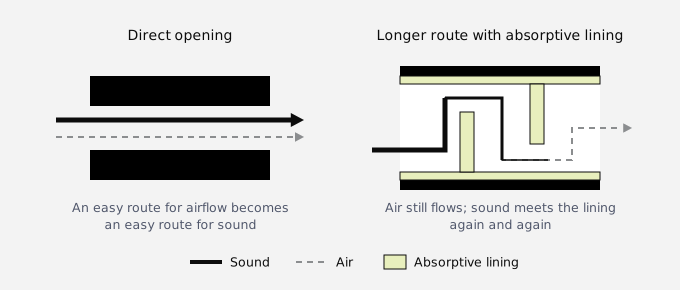
For buyers, the important distinction is between having a ventilation opening and having an acoustically considered ventilation system. Both may look unobtrusive from outside; their treatment of sound can be very different.
Persy Booths seeks to balance these routes against the performance target and cost. As Troy puts it: “We don’t want to overbuild one path because it doesn’t matter. The sound is going to go somewhere else.” The aim is to identify where additional material would improve the complete enclosure, rather than improving a specification in isolation – which would not deliver much additional value to the customer.
Windows deserve the same whole-construction thinking. Even well-performing glass must connect properly to its frame and adjacent panels. A buyer does not need to know the precise properties of every seal, but should recognise that the glazing specification and the quality of its installation answer different questions.
Nor should a ventilation solution be judged only on whether it suppresses escaping speech. The fan itself is another potential sound source. Ask to hear the booth with its normal ventilation operating: the equipment needed to make an enclosure comfortable should be included in your experience of it.
How does theory compare to real-world performance?
Acoustics experts are always aware of the difference between computer drawings and manufactured products. In a model, two surfaces can meet perfectly. Real components in real life tend not to work so well. They have manufacturing tolerances for a start, and those small dimensional differences must be accommodated in the design and assembly. A carefully calculated enclosure can consequently underperform if the finished product leaves an unintended opening.
Also bear in mind that office requirements change and booths often have to be moved. If anything is going to put manufacturing quality to the test it will be the booth’s ability to withstand the move without opening up tiny cracks and fissures in the construction.
Frequently Asked Questions
Why do booth doors matter so much?
A door must open and close repeatedly while still meeting its seals consistently. A small unintended opening can provide a relatively easy path for sound, even when the panels are excellent. Check fit, latching and seal condition, and ask how those parts are maintained over time.
Does ventilation let sound escape?
Air needs a route through an occupied booth, and an untreated opening can also carry sound. Good design considers the ventilation path acoustically, for example by using a longer, treated route while maintaining adequate airflow. Listen to the booth with its ventilation operating, including any fan noise.
Will moving a booth affect its soundproofing?
It can if disassembly, transport or reassembly changes the fit of joints, glazing or door seals. That does not mean movable booths are inherently poor performers. Ask the supplier about relocation procedures, inspection and adjustment, and whether the intended acoustic performance can be maintained after a move.