


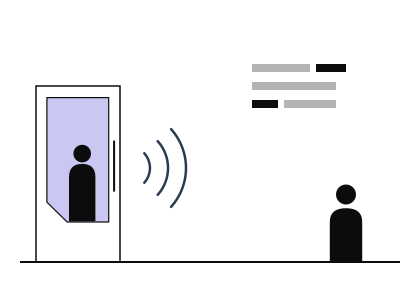


If someone outside a soundproof booth can hear you talking, does that mean your conversation isn’t private? Not necessarily. Drawing on an interview with Troy Bouman, a PhD-qualified acoustics and noise engineering expert, we explore the difference between hearing a voice and understanding its words. This is an excerpt taken from the report An Acoustician’s Guide to Soundproof Booths.
An HR manager needs somewhere to discuss a salary review. Outside the booth, a colleague can hear a faint voice. Is that a privacy failure? The crucial question is whether the colleague can understand anything sensitive.
For a private conversation, hearing a voice and understanding what it says are different outcomes. Acousticians like Troy Bouman see the distinction between audibility and intelligibility as one of the most useful ideas for anyone assessing what “soundproof” ought to mean.
Audibility concerns whether a sound can be heard. Intelligibility concerns how much of the speech can be understood. Reducing one does not give you a simple, universal answer about the other.
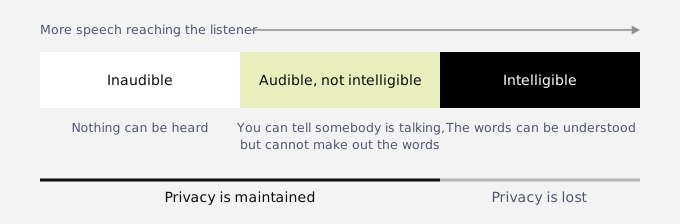
How can you measure whether speech is understandable?
The background sound where somebody is listening plays an important part. A voice that escapes into a busy office may be difficult to distinguish from everything around it. When the office empties, the same voice may become easier to follow even though the booth itself has not changed.
An acoustics expert therefore considers the speech reaching the listener relative to the background at that position. How loud somebody speaks matters too. A calm conversation and an animated call do not present identical challenges.
Troy refers to a measure called the Speech Transmission Index, or STI, to assess how intelligible speech is when it reaches a listener, taking account of factors including background noise and reverberation. Developed by Dutch researchers and now defined in an international standard, it uses a scale from zero to one, with higher scores indicating that speech is easier to understand. A colleague speaking with a clear voice in a quiet room will be a higher number: a barista asking about your coffee order over the clanking of cups in a coffee shop will be lower.
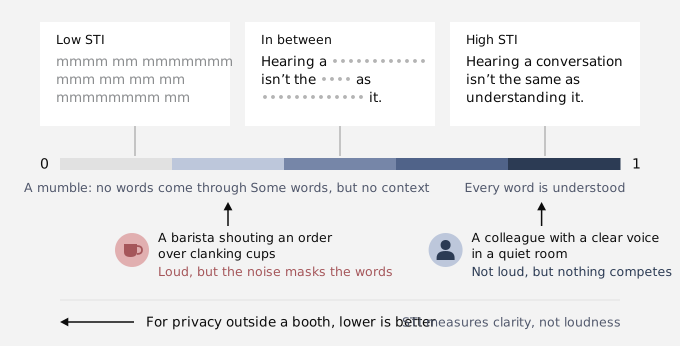
What other factors affect intelligibility of speech?
People also bring knowledge to what they hear. If that knowledge helps them to fill in the gaps, a lower STI number is required. Imagine a colleague already knows a conversation concerns salaries. A name and a number might reveal something meaningful, even if most of the sentence is lost. The listener’s knowledge can turn fragments into a message, whereas a stranger hearing those same fragments might learn very little. As Troy puts it: “Having context to the sentence actually changes your ability to understand if something is intelligible or not.”
Privacy therefore deserves assessment against plausible listeners and conversations, rather than a demonstration in which nobody knows what the speaker is discussing. That makes privacy a more demanding question than “Could you hear anything?” A demonstration should consider whether somebody can recover meaningful content, not simply notice a voice.
Does soundproofing work both ways?
Yes: acoustic scientists call it acoustic reciprocity. A soundproof booth will not only prevent conversations being heard outside, but also reduce incoming office noise for the person inside. As a general principle, and in typical office situations, a sound path works in both directions. But that does not make the two practical requirements identical. Quiet for concentration and privacy for a call involve different sources, listeners and expectations.
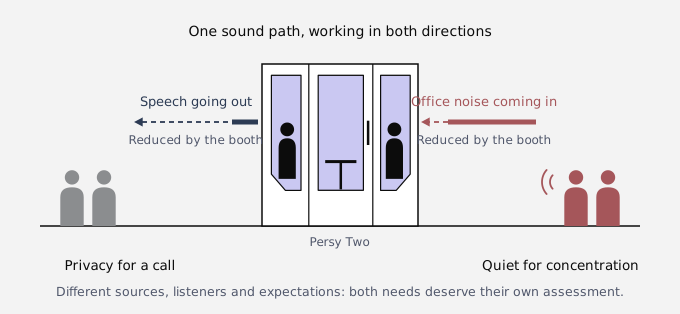
A booth can therefore be comfortable to work in without necessarily being suitable for every confidential conversation. Both needs deserve their own assessment.
Frequently Asked Questions
Can people hear you in a soundproof booth?
Sometimes they can detect that somebody is speaking without understanding the words. That distinction matters: audibility is not the same as intelligibility. The result depends on the booth, speaking level, listener position and background noise, so a blanket promise of complete silence is not realistic.
Is a booth private enough for HR or salary conversations?
It may be, but the acoustic rating alone cannot guarantee confidentiality. In a quiet office, even fragments such as a name or salary figure may be meaningful. Test with a realistic listener outside, consider sensitive subjects and adopt additional privacy procedures when the consequences of disclosure are high.
Does a quieter office always improve privacy?
No. A quieter office can make escaped speech easier to distinguish because there is less background sound to mask it. The same booth may appear more private during a busy afternoon than after most colleagues have left. Consider the quietest realistic operating conditions when assessing sensitive calls.