


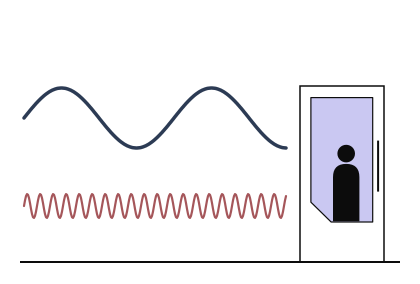


Not all sounds are created equal, and some are much harder to stop than others. So how do you know what level of soundproofing your workplace really needs? Drawing on an in-depth interview with Troy Bouman, a PhD-qualified acoustics and noise engineering expert with two decades of experience, we explore how to define the problem before choosing a booth. This is an excerpt taken from the report An Acoustician’s Guide to Soundproof Booths.
A facilities manager is asked to find a quiet place for video calls, but the office sits beside a busy road. Should the new booth be designed around voices, traffic or both? The answer starts with identifying the sound problem, not choosing the biggest decibel figure.
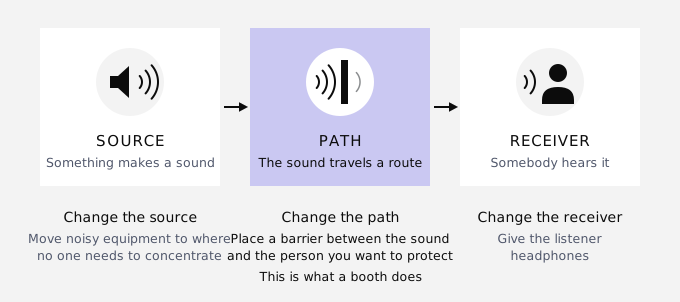
When acoustics experts like Troy Bouman consider a soundproofing exercise, they usually begin with a basic framework that makes this complicated subject a little easier to understand: source, path, receiver. Something makes a sound, that sound travels along a route, then somebody hears it. Understanding those three things gives an acoustician a starting point for deciding what needs to change.
Sometimes the simplest answer is to change the source. For example, you could simply move a noisy piece of equipment to a part of the building where no one needs to concentrate, and you remove the problem altogether. No need to buy anything.
Sometimes you can change the situation of the receiver, for example by giving them headphones. The main reason for buying a booth, however, is to change the path, placing a barrier between the sound and the person you want to protect.
Why Is Low-Frequency Traffic Noise Harder to Block?
If you are looking to block sound, an important point to understand is that sound is not one uniform thing. Sounds arrive simultaneously in a range of frequencies. A low mechanical rumble and a higher-pitched voice can meet the same wall and experience very different reductions.
Acousticians explain this through wavelength. In the same way that waves in flowing water might bend around a rock, sound waves also bend around objects. These sound waves have physical lengths, and lower-frequency waves are longer. The low rumble of traffic can contain sound waves several metres long. The bright clink of a glass might have a wavelength of just a few centimetres. Both reach the same booth (and possibly the same person within it), but they present very different acoustic challenges.
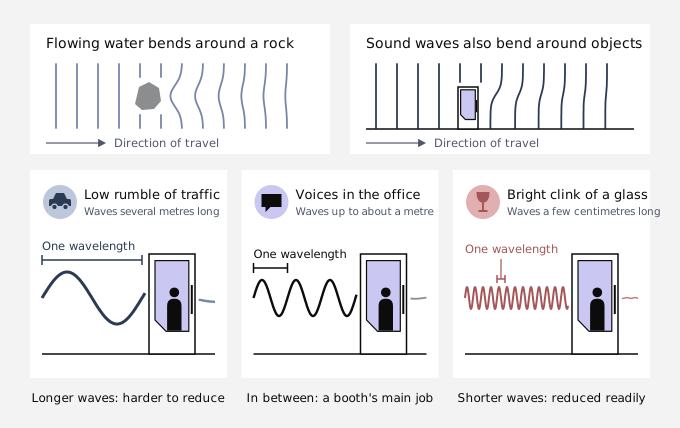
One familiar consequence is that low sounds with longer wavelengths are more difficult to reduce. Think of traffic outside a hotel: with the window closed, you may still hear a rumble. Open it and you suddenly hear a much broader range of sounds.
For a buyer, the useful lesson is that a booth’s performance changes across frequencies. A product that reduces ordinary office conversation effectively may leave more of a low mechanical hum audible, but that does not automatically mean it is badly designed. It may mean the sound you are asking it to tackle falls outside its intended brief.
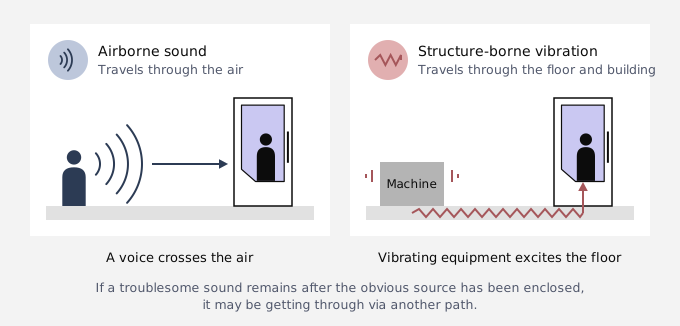
There is also a useful distinction to make between airborne noise and vibration travelling through a structure. A voice crosses the air; vibrating equipment can also ‘excite’ the floor or elements of the building construction. Describing everything as “noise” can conceal those different routes. If a troublesome sound remains after the obvious source has been enclosed, it may be getting through via another path.
This is why acousticians spend time establishing acoustic targets before considering materials. The starting point is the likely sound outside or inside the booth, followed by the conditions required where somebody will be listening.
How Much Soundproofing Does an Office Booth Need?
The ultimate aim is perfect silence, right? Not usually. An acoustician would be more practical about it: decide which sounds need reducing, for whom and to what level. In Troy’s words: “You have to pick the right targets. That’s where you start.”
Concentrating on a spreadsheet, recording a voiceover and discussing somebody’s salary are three different activities. They should not automatically be given the same acoustic brief simply because they happen in a booth. As Troy puts it:
Buyers should consider the consequences of failure: you’ve got to be a lot more careful with conversation privacy in a top-secret military facility than you do in a community library.

Troy Bouman, PhD
Acoustics and noise engineering expert
More demanding acoustic targets can mean a booth needs greater weight or more complex construction, both of which lead to higher cost. Those additions need to serve an identifiable purpose or it is money wasted on over-specification.
For an office buyer, this need not become an engineering exercise. It means giving a supplier an honest picture of the surroundings, rather than expecting a standard product to solve an unspecified problem. The clearer the brief, the more meaningful the recommendation.
Frequently Asked Questions
How much soundproofing does an office booth need?
There is no single figure that suits every office. A booth used for ordinary calls may need a different level of isolation from one used for sensitive discussions or beside machinery. Define the activities, surrounding noise and consequences of speech being overheard before comparing test results.
Will a booth block traffic rumble as well as voices?
Not necessarily. Low-frequency traffic and mechanical noise can be harder to reduce than speech, and a speech-focused rating does not describe every sound equally well. Ask for frequency-specific evidence where possible and try the booth against the noise that actually troubles your workplace.
Can headphones replace a soundproof booth?
Headphones may help one person concentrate, but they do not prevent colleagues hearing that person speak. A booth changes the path sound takes between people. If your aim is private conversation rather than simply reducing distraction for the wearer, headphones alone may not solve the problem.